


Newsweek journalist reports, “Watching my first abortion”
 I wrote this morning that showing the reality of abortion tosses “pro-choice” platitudes out the window.
Newsweek reporter Sarah Kliff wrote a nice pro-abort puff piece about late-term abortionist LeRoy Carhart but in a related piece reported running into emotional trouble when actually watching him commit the dirty deed:
… But I’d never actually seen an abortion; I’d never watched the procedure that activists vehemently defend or deplore…. I wasn’t sure I would. I confess I was hesitant to step into Carhart’s operating room….
A 1st-trimester abortion, from my vantage point behind the glass window, looked like an extended, more invasive version of a standard ob-gyn exam. A woman with her heels in stirrups, clothes traded in for a hospital gown, a speculum holding the cervix open. Carhart used a suction tube to empty the contents of the uterus; it took no longer than 3 minutes. The suction machine made a slight rumbling sound, a pinkish fluid flowed through the tube, and, faster than I’d expected, it was over…. I’d anticipated some kind of difficulty watching an abortion; it wasn’t there.
At least not physically. But there was a discomfort I hadn’t expected, my emotional reaction to watching abortions….
When I returned from Omaha, friends and colleagues wanted to know if I had “done it.” When I said I had, their reactions surprised me. Friends who supported legal abortion bristled slightly when I told them where I’d been and what I’d watched. Acquaintances at a party looked a bit regretful to have asked about my most recent assignment. The majority of Americans support Roe v. Wade’s protection of abortion, about 68% as of May. But my experience (among an admittedly small, largely pro-choice sample set) found a general discomfort when confronted with abortion as a physical reality, not a political idea. Americans may support abortion rights, but even 40 years after Roe, we don’t talk about it like other medical procedures.
And maybe that’s appropriate. Abortion may be a simple procedure medically, but it is not cancer surgery. It’s an elective procedure that no one – neither its defenders nor its detractors – expects to elect for themselves. I had (and still have) difficulty understanding my own reaction, both relieved to have watched a minimally invasive surgery and distressed by the emotionality of the process. Abortion involves weighty choices that, depending on how you view it, involve a life, or the potential for life….
Not only did her own reaction to abortion surprise Kliff, but also the reactions of her “large pro-choice sample set” – friends and colleagues. They approve of the concept of abortion but don’t like being reminded of the reality.
Kliff is having “difficulty understanding” her reaction to the graphic reality of abortion that confronted her pro-abort self.
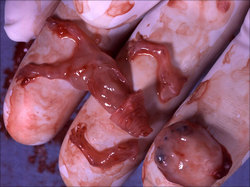
[Bottom photo of 8-week-old aborted baby attribution: Center for Bio-Ethical Reform via Abort73.com]

 Jill Stanek is a nurse turned speaker, columnist and blogger, a national figure in the effort to protect both preborn and postborn innocent human life.
People who didn’t face the horror and brutality of slavery in the American south could simply view it as a political issue as well.
Those that didn’t live or witness discrimination, lynchings, and the daily humiliation of black citizens in the Old South could easily view segregation as just a political issue.
Not viewing the death camps made the Final Solution sound so sanitary.
Detaching human beings from the injustice inflicted upon them just somehow makes it more tolerable.
“Minimally invasive procedure” — but not for the baby.
My experience as a Viet Nam vet and as (unfortunately) an eye-witness to a mass murder (Charles Whitman in the Tower at UT) and to two accidental deaths (balloonists, one burned to death and one who fell to his death) is that no normal person who sees a killing or horrible things happening to human beings is ever the same again. Being present at the death of a loved one (I was there when each of my parents passed away) is terribly hard, but even that is not the same as seeing someone die at another person’s hands.
We don’t understand violent death by knowing it only as a theoretical concept. We only understand it in our visceral reaction when we see it. People know this instinctively, which, I believe, is why they don’t talk about abortion, and when they do, they don’t talk about it the same way they talk about having their wisdom teeth out.
The reporter in this story now understands violent death in a new way, and she will never be the same.
Those pictures always make me so sad. I would have taken in any of those babies, and loved them. How can anyone do something so cruel. I have seen these kinds of images for years but they never stop having that effect. It’s the reality of the gruesome killing that will never go away.
Sarah Kliff obviously did not assemble the remains of the child, but only looked at the aspiration technique. That’s not the whole story Sarah.
You need to go back, assemble the complete child, then take a small sample to look at the DNA. Then ask the question how a potential life could actually grow with that unique DNA from the zygotic stage, with the DNA always and completely identifying that unique individual.
Because the remains aren’t potential – they’re real, and the life that grew was eliminated right before her eyes.
The only differences – Size, Level of Development, Environment and Degree of Dependency didn’t change the humanity of the
child, whose execution you witnessed.
Come now Sarah – what was it really like?
Bill,
Thank you for your service to our country.
My thoughts were similar to Chris A.’s comments above when I read this article. What’s the matter, she was OK with watching the abortion but too chicken to watch the reassembling the child afterward? After all, making sure they “got it all” is an important part of abortion, and it would have shown her the TRUE reality. Not the “safe and sanitary” (not!) half. And since when is forcibly dilating a woman’s cervix and shoving an instrument into an internal organ (the uterus) to forcibly rip apart and vacuum out a child “minimally invasive”? Has she got rocks in her head? Would she be willing to have someone “probe” her internal organs with a suction machine or any other instrument? Has she actually interviewed a REAL OB/GYN to see what the risks of such a procedure ARE?
This is just typical pro-abortion chicanery. Just tell half the story, we’ll keep the rest of the truth hush-hush because it’s not pretty and politically-correct. Someone might actually GET why abortion is morally wrong if we let them see the rest of the story. And you know, that’s bad for business.
Posted by: Bill at August 17, 2009 7:23 PM
——-
Bill – thanks for your service.
I understand most combat veterans know who has seen serious combat, and who hasn’t, simply by looking into the other person’s eyes.
The big problem with our stand-off video enhanced targeted weapons systems – they so remove the combatant from the reality of the violence unleashed, there’s no visceral reaction. Obviously the same is true when it comes to “choice”.
I’ve never seen combat, but during my tour of service in the US Army I witnessed a divisional TOT (time on target). 96 rounds of high explosive artillery hitting the area the size of a football field within 6 seconds. It was fascinating/horrible.
It’s quite scary where man can go…I imagine some abortionists have fascination/horror when they perform the procedure.
Posted by: army_wife at August 17, 2009 7:55 PM
“Abortion involves weighty choices that, depending on how you view it, involve a life, or the potential for life….”
The ignorance and/or intellectual dishonesty has clouded the abortion debate. It blows my mind that people still speak as if a human life’s existence is determined merely by one’s view point. There is so much time being (sometimes intentionally, perhaps?) wasted debating something that is settled scientific fact: human life begins at conception.
I have quite a few friends who have had abortions. They talked of how they found out they were pregnant, made the decision to abort and were stoic about it. Then when the day came they broke down in torrents of tears and vomit. Snot ran out of their noses as they sobbed and wailed at the horror of their choice. Abortion can be politicized and wrapped up as a pretty package but those who see it, do it and experience it cannot deny its horror and the despair and grief that accompanies it.
Even years later my friends (some who even remain “pro-choice”) talk with lumps in their throats about the babies they once carried but will never know. It fills me with grief too. I wish society would wake up and stop this insanity!
Bill, thank you so much for your service. I have family members who have served in a variety of wars and a variety of capacities; it is not an easy thing.
And I agree with you, that seeing violent death — or even just violence — whether intentional or accidental can affect and alter a person forever.
I have been lucky in my life; experienced violence personally, but not a violent death (though it feels risky to say that, not knowing what the future holds). There are some things that change you. I used to view it as “I had been changed into someone else,” but now I try to view it as, “I have changed into myself.” The only trick is making myself into a triumph of hope over horror, rather than another example of the exponentially hopeless effects that horrific events can have.
And since when is forcibly dilating a woman’s cervix and shoving an instrument into an internal organ (the uterus) to forcibly rip apart and vacuum out a child “minimally invasive”?
My thoughts exactly.
And I still cannot comprehend how people can claim to be unaffected by these pictures.
You see, whether or not one beleives in God is irrelevent.
What Sarah Kliff probably does not realize, is that God, who is all righteous, is speaking to her in her conscience.
What Sarah is feeling that she doesn’t understand, or can’t explain, is God trying her heart and mind. What she sees (the abortion) she understands. What she doesn’t see, but feels, (her emotional reaction) she doesn’t understand.
So, whether or not she believes that there is a God is irrelevent, because He is there, and working in her.
Psalm 7:9 (New American Standard Bible)
O let the evil of the wicked come to an end, but establish the righteous;
For the righteous God tries the hearts and minds.
“I had (and still have) difficulty understanding my own reaction, both relieved to have watched a minimally invasive surgery and distressed by the emotionality of the process.”
Someone should remind her that she’s human; it’s natural to be distressed by someone’s death. She has been brainwashed by pro-aborts and might want to get counseling.
Perhaps Sarah is a budding convert. We will lift her up in prayer.
One thing very striking about the story was the reaction of her colleagues. Whereas Sarah did talk to the women undergoing abortions and seemed to connect with them, at least briefly on an emotional level, the colleagues did not have question one about them.
Their reaction reflects the coldness and dispassionate distance that “choicers” often keep between intellectual acquiesence of the “right” to abortion on the one hand, and acknowledging the full consequences of abortion on the other hand. They cannot allow themselves to be taken in with concern for the latter because it gets into things that sound an awful lot like what pro-lifers have been saying.
One senses that they do not allow themselves to have much pity for the struggle these women are enduring. It is like they are thinking: Hey, it is their choice, they made it, it can be tough sledding, but get over it. Be a big girl and get on with your life.
She just witnessed the death of a child, no wonder her writing seems a bit confused. Although she did not actually SEE the tiny child torn to pieces, she is happy enough to hide behind her words.
The rest of the story…..follow the post-abortive women around for a couple of years and see how they are “getting on with their lives.”