


Quote of the Day 12-19-10
I didn’t originally intend for my 4-Sunday history of Christmas hymns to be all about slavery. But since I as a pro-lifer identify with the abolitionist movement, which sought to free an oppressed people considered property and not persons, I was drawn to the story behind “O Little Town of Bethlehem” the 1st week and then “Go Tell It on the Mountain” the 2nd.
I have been surprised to find a rich slavery heritage behind and within many of our beloved Christmas hymns and so will carry out that theme this Sunday and next. Today…
O Holy Night
In 1847, his parish priest asked French poet Placide Cappeau de Roquemaure to compose a Christmas poem. He wrote “Cantique de Noel” while contemplating what it would have been like to be present at Christ’s birth and asked his friend Adolphe-Charles Adam to set it to music.
The song became an instant classic in France but was later denounced by the Church after Placide himself denounced the Church and became a Socialist Communist, and it was also learned Adam was a Jew.
 A decade later American abolitionist and pastor John Sullivan Dwight learned of the beautiful song and saw something more when translating it into English.
According to Ace Collins in his book, Stories Behind the Best-Loved Songs of Christmas, Verse 3 “supported Dwight’s own view of slavery in the South…. Dwight’s English translation of ‘O Holy Night’ quickly found favor in America, especially in the North during the Civil War.”
According to Wikipedia, here is the literal English translation of Verse 3:
The Redeemer has overcome every obstacle:
The Earth is free, and Heaven is open.
He sees a brother where there was only a slave,
Love unites those that iron had chained.
Who will tell Him of our gratitude,
For all of us He is born, He suffers and dies.
And here is Dwight’s translation of Verse 3:
Truly He taught us to love one another;
His law is love and His gospel is peace.
Chains shall He break for the slave is our brother;
And in His name all oppression shall cease.
Sweet hymns of joy in grateful chorus raise we,
Let all within us praise His holy name.
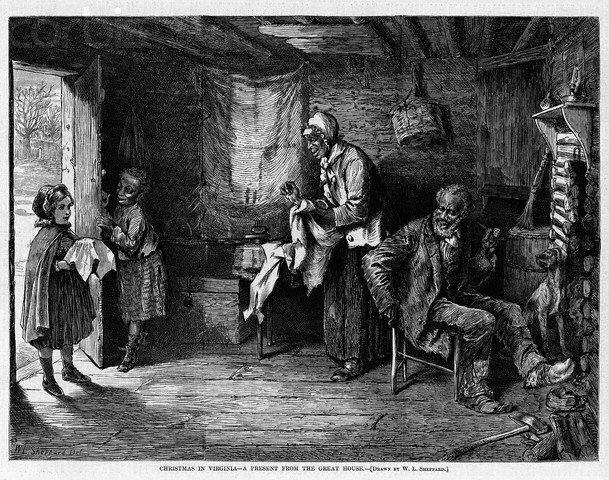
[Drawing above entitled, “Christmas in Virginia – A Present from the Great House,” c 1871. Click portrait to enlarge. According to CorbisImages.com: “For Christmas, a young white girl brings food from the plantation house to ex-slaves still living on the estate.”]

 Jill Stanek is a nurse turned speaker, columnist and blogger, a national figure in the effort to protect both preborn and postborn innocent human life.
1947 ??
Thank you Jill, I was so blessed to read that.
Thanks Jill –
Wikipedia shows 4 different translations/versions (never knew that) and then, of course, performers have their own interpretations. Here are 2 great ones:
http://www.youtube.com/watch?v=cZ-8jYpa1-o&feature=related
http://www.youtube.com/watch?v=cRqycwRFWuc
That song is one of my favorites, and verse 3 gets me every time. Nice to know the history. Thanks!
Thanks Jill. I was really blessed to read this.
Jael, yes, whoops, sorry, fixed. All, I appreciate that this encouraged you as much as it encouraged me.
Truly, we are all “persons not property.” Thank you Jill for all you do. “Let all within us praise His holy name.”
anyone read the story behind “O Holy Night”? sounds somewhat like Saint Vincent DePaul’s story.